
Why a Eutectic System is perfect as marine refrigeration
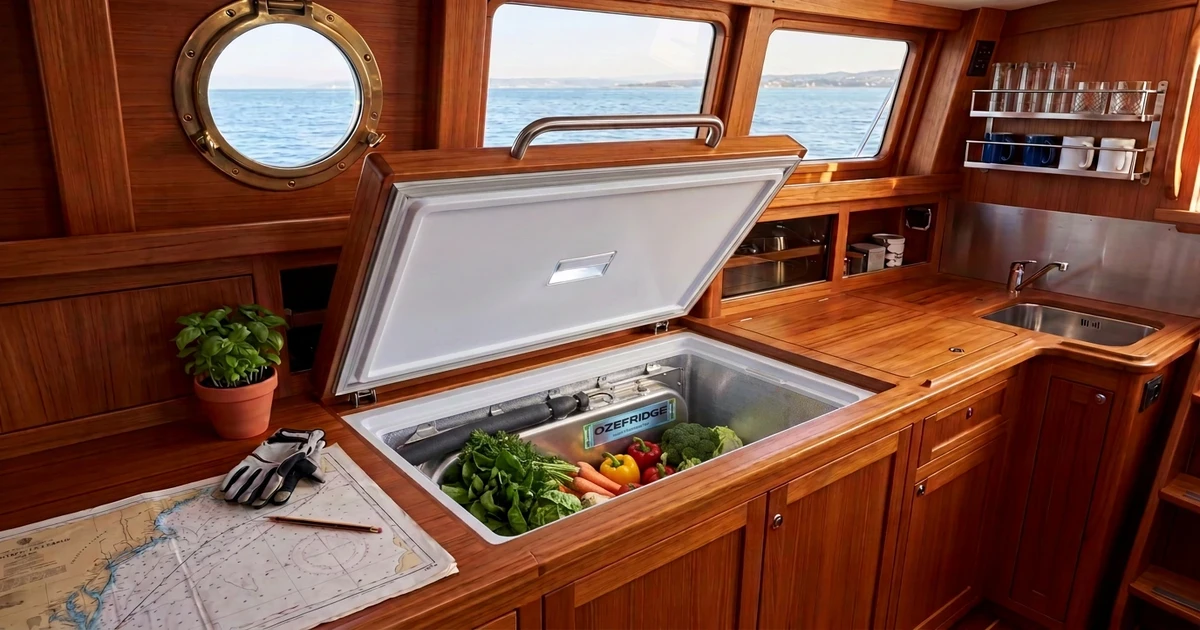
We all know the supply of electrical energy on board for cruisers is often erratic at best. Effective storage of electrcial energy is then critical for periods when solar, wind or whatever is not available. This is usually done by battery with very limited storage capacity. Another question then arises: When the limited energy storage is full, where can any excess power go? To stop abundant power going to waste, a bigger battery bank is the way to go, RIGHT??? But what if there is a better way.
What is Eutectic?
The metric measure of heat as in watts. This is the standard in calculation of cabinet heat loads, compressor output, COP (more on this below). For our imperial measurements, this would be BTU.
Approx. one watt of heat must be removed to lower the temperature of one litre of water by one degree centigrade. See Wikipedia page about Sensible Heat.
Approx. 93 watts of heat must be removed to lower (through phase change) one litre of water from a liquid to a solid frozen mass and vice versa. See Wikipedia page about Latent Heat.
Using water alone as a medium of thermal energy storage is not ideal as it’s phase change temperature of 0C is not cold enough. Salt or glycol is then added thereby lowering the phase change temperature hence where the term “Eutectic” comes from. However, this reduces the Latent heat factor to approx. 85 watts per litre for fridges with phase change occur at approx. -5C (and less again for freezers). This is still a significant thermal storage that can be applied in periods when solar, wind or other forms of energy is not available.
Eutectic Refrigeration: Reducing demand on batteries
A eutectic refrigeration system employs the same essential components as any refrigeration system with one key feature. Instead of a standard aluminium evaporator cold plate, a eutectic system utilizes a specialized tank which contains both the evaporator coil bathed the eutectic solution.
To phase change eutectic solution to ice involves a refrigeration unit removing 85 watts of heat per Liter, while consuming electrical energy at a rate that is determined by its operating COP (see later). Once the eutectic solution is turned to ice, the unit shuts off and the frozen eutectic solution absorb approx. 85 watts of heat per litre as it thaws while maintaining cabinet temperature.
A eutectic tank that contains 5.1 litres of eutectic solution requires a minimum of 433 watts of heat to be removed to phase change from a liquid to a ice (same also the other way around). This requires a minimum of one long run of at least 3hrs 25minutes of system run time for a 3.5cc refrigeration system to move that much heat.
Therefore, if there is abundant power available by say midday, but the batteries are already charged up, the eutectic system can start its long refrigeration cycle. This converts your excess electrical energy into thermal energy for later use. This in turn decreases the demand on your batteries later and instead can be allocated to other essential electrical equipment e.g. lights, navigation equipment. With a massive block of eutectic mass constantly absorbing heat, the cabinet temperature is maintained. This is similar to a cold drink not increasing in temperature due to the ice absorbing the heat while undergoing phase change to liquid. The eutectic system doesn’t need to run until the frozen eutectic mass is fully thawed.
COP: Key to efficiency yet nobody knows about it
A eutectic system is always absorbing cabinet/product heat 100% of the time weather compressor is on its long run cycle or not. In comparison, a cyclic system only absorbs heat while the unit is running say 25% of the time. This allows the eutectic system to do its job without having to operate at very low temperatures that the cyclic needs to when running to compensate. Typically, a eutectic system operating as a fridge would maintain its eutectic tank/solution core between -2c and -10c resulting in cabinet temperaure of around about 2C. While a cyclic system would need to operate down to -23C to get the required refrigeration in the shorter periods.
The COP of a refrigeration system refers to the number of watts of heat removed for each watt of electrical energy consumed and is indicated as w/w (coefficient of performance). The more watts of heat removed per watt of power consumed, the better. This is the industry recognized method of evaluating efficiency.
This is where the first operational power saving of a eutectic system originates from. The cyclic system with a -23C evaporator has a poor COP of 1.01. In contrast, a eutectic system with a -10C evaporator has a COP of 1.41. Same compressor, same compressor speed, same cabinet but operating on different temperatures.
The second power saving of a eutectic system is due to less total start up current per day. A eutectic system only needs to start and run when the eutectic solution is fully thawed, typically one or two startups per day. On the other hand, a cyclic system has approximately 40x per day although todays ‘soft start’ Motor Driver Module or MDM have reduced start-up loses considerably. Startups require approximately 30-100% more current for a few seconds to get the compressor going. Its like pushing a car from rest requires a lot more energy compared to maintining it in motion. Startups also put immense amount of strain on mechanical and electrical components. The more startups, the more the life expectancy of the refrigeration system is reduced.
The above simply establishes the considerable power efficiency advantage of the eutectic system compared to a cyclic system in normal circumstances.
Conclusion:
Not only that a eutectic refrigeration system is far more power efficient, it also acts as your secondary energy storage for your unused electrical power while at the same time providing refrigeration for longer periods without needing to consume power.
Not sure what suits your needs, please see our Ozefridge Heat Load Calculator to find out what system you need.
