Power on a boat is hard to keep steady. Solar and wind power change with the weather.
Most cruisers use batteries to store electricity. But batteries have very limited space.
What happens when your boat batteries are full on a sunny day? Where does the extra solar power go?
You might think you need a bigger, heavy battery bank. But there is a much better way.
You can store that extra power as cold thermal energy.

What is “Eutectic” Storage?

To understand this, we need to look at how we measure heat. We measure heat in watts (just like electricity).
    • Sensible Heat: It takes 1 watt of cooling to drop the temperature of 1 litre of water by 1 degree Celsius. Please see Wikipedia about Sensible Heat.
    • Latent Heat: It takes a massive 93 watts of cooling to turn that same litre of water into solid ice. Please see Wikipedia about Latent Heat.

Turning liquid into ice stores a lot of cold energy! But plain water is not cold enough for a boat fridge. So, we add salt or glycol to the water. As a result, this new mixture is called a eutectic solution.
A eutectic solution  freezing at -5°C is ideal for a fridge. Additionally, it stores about 85 watts of cold energy per litre. This frozen mix acts like a giant battery for coldness.

How It Works: Reducing the Load on Your Batteries

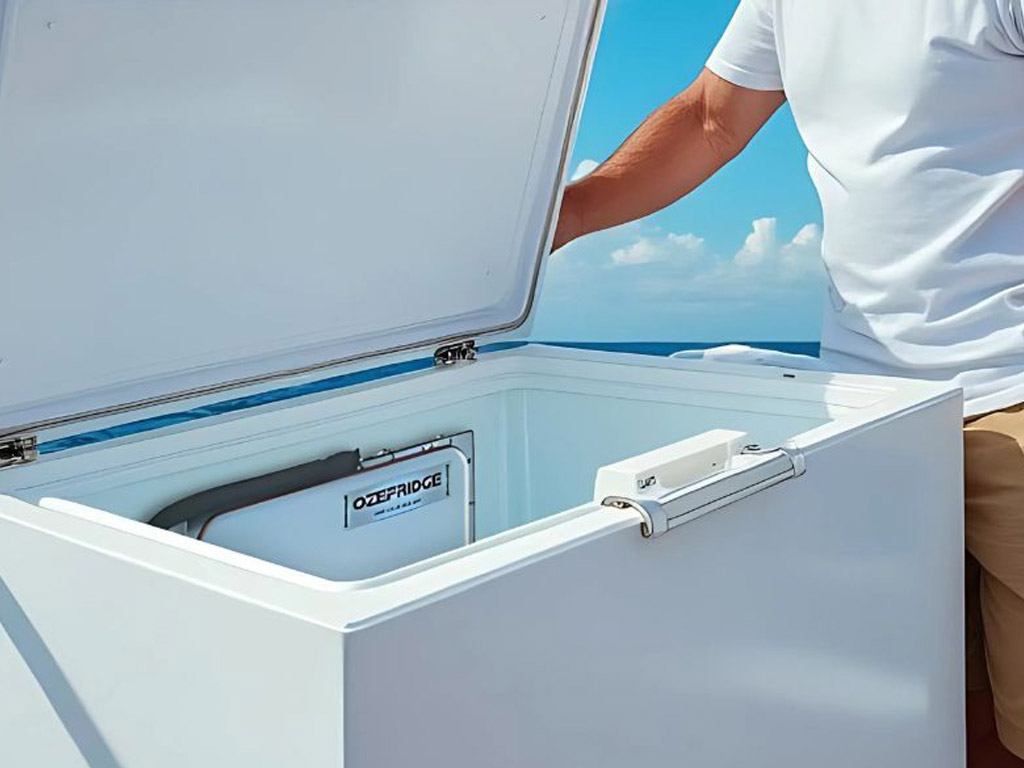
A eutectic fridge looks like a normal fridge, but it has one big difference.
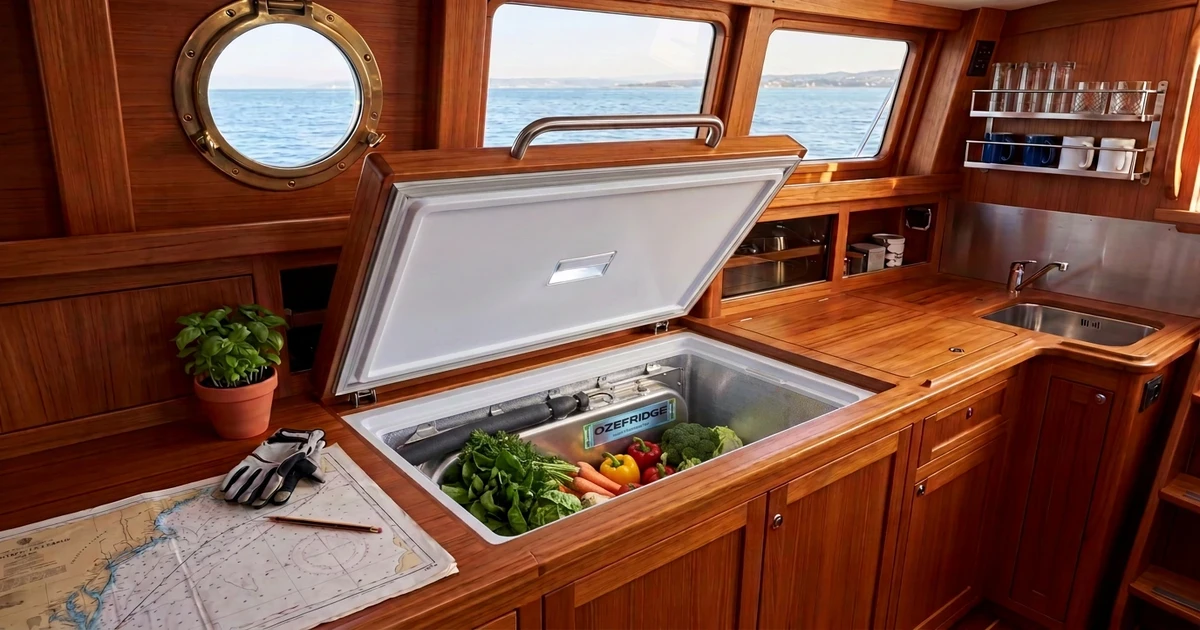
Instead of a thin metal cooling plate, it uses a tank filled with the eutectic liquid. Also inside the tank is the refrigeration cooling coil (technical refrigeration term “Evaporator”).

Here is how the cycle works:
    1. The Freeze: The fridge motor runs and turns the eutectic solution into ice.
    2. The Hold: The motor turns off.
    3. The Melt: The ice slowly melts, keeping your food cold for hours without using any electricity.

For example, a small 5-litre tank needs about 3.5 hours of continuous running to freeze solid.

Imagine it is midday and your solar panels are soaking up the sun. But your boat batteries are already 100% full. Instead of wasting that free solar power, your eutectic fridge turns on. The eutectic system instead uses that extra sun to freeze the eutectic solution. So at night, the fridge can stay off while the frozen eutectic solution keeps your food cold. As added benefit, your batteries can then focus on powering your lights and navigation tools.

COP: The Secret to High Efficiency

Efficiency is measured by COP (Coefficient of Performance). This is the amount of heat a fridge removes for every watt of power it uses. The higher number, the more efficient the fridge is.

Eutectic fridges are far more efficient than standard (cyclic) fridges for two major reasons:

1. Better Temperatures
    • Standard Fridges: They turn on and off quickly due to lack of thermal storage (it is just a thin aluminium plate after all). To compensate for this, they must run at a freezing -23°C much like their version of cooling in advance. However, this gives them a poor COP of 1.01.
    • Eutectic Fridges: They hold their coldness better due to the frozen eutectic mass constantly absorbing heat. They only need to run at -10°C to keep the food at a perfect 2°C. This gives them a great COP of 1.41.

2. Fewer Startups
Pushing a stationary car into motion takes more energy than keeping it moving. Fridge motors are the same. As a result, starting up uses 30% to 100% more current for a few seconds.
    • Standard Fridges: Turn on and off 40 times a day. This wastes power. On top of that, each time a motor/compressor start puts tremendous strain on mechanical and electrical parts. Therefore, life expectancy is reduced. 
    • Eutectic Fridges: Only turn on 1 or 2 times a day. They run for a long time, freeze the block, and shut off. This saves your energy and protects your equipment.


Summary

A eutectic fridge does two jobs at once: It keeps your food fresh, and it acts as a secondary storage bank for your extra electrical power. This is the smartest way to upgrade your boat.

Want to find the perfect setup for your boat? Use our Ozefridge Heat Load Calculator to discover exactly what you need for your next cruise!
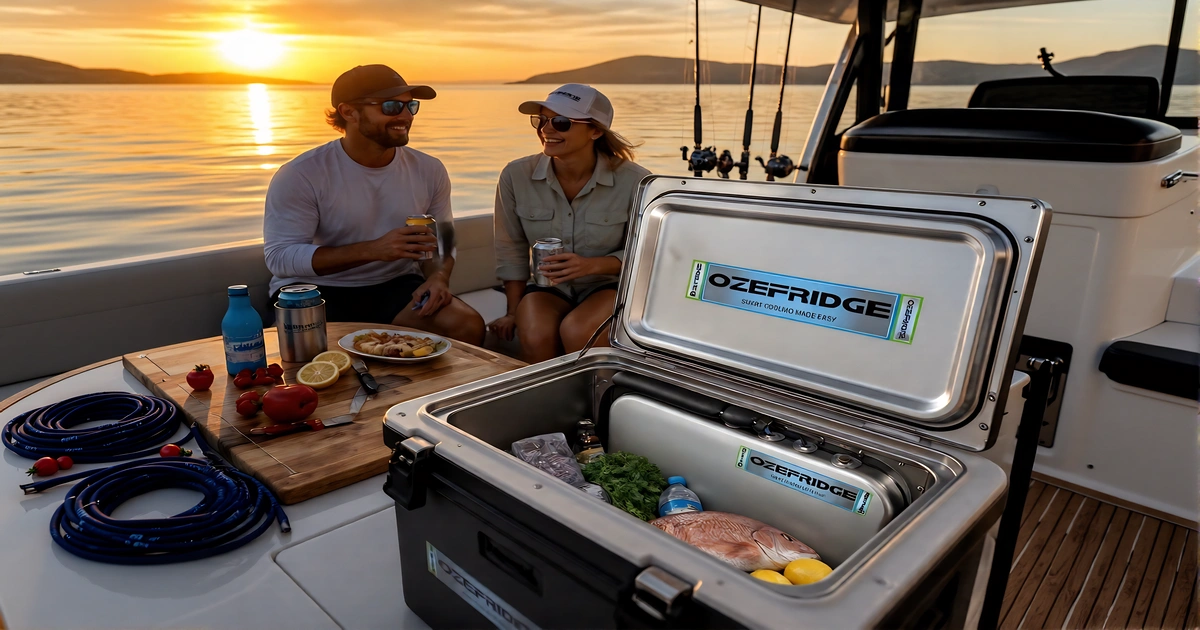
 

Keeping your cool on board can be a challenge. Wet sails, a stressed-out crew, spoiled food, and warm drinks, does this sound familiar?

While we cannot fix the weather or the crew, we can definitely solve your galley woes. Nothing turns sailing stress into absolute bliss quite like a crisp, ice-cold drink. To achieve that bliss, today’s mariners need a reliable marine refrigeration system that actually works, thrives on minimal power, and stops causing aggravations. Here is how modern marine technology is unlocking the confusion of on-board cooling.

How Refrigeration Actually Works

The biggest mystery to unlock about refrigeration is this: systems lower temperatures by removing heat, not by adding cold.
Please see refrigeration Wikipedia page to learn more. A marine refrigeration system works in a continuous recycling loop using three major components:
    • The Evaporator: Located inside your fridge cabinet, acting as the heat collector.
    • The Condenser: Located outside the cabinet, acting as the heat disposer.
    • The Compressor: The pump that circulates refrigerant gas between the two.
    • Refrigerant Metering Device: Provides pressure drop to enable evaporation of liquid refrigerant in the Evaporator and thereby collecting large amounts of heat in the process.

Think of it like the water-cooling system in your car. Gas circulates through the loop, absorbing heat from inside the fridge and dumping it outside.

If your condenser cannot get rid of that heat efficiently, the whole loop gets choked. A restricted condenser forces the system to run excessively, drain your battery bank, and fail to cool when the weather gets hot.

Marine Refrigeration: Unlocking the Confusion

At its core, a marine refrigeration is just a domestic refrigerator that can run on battery power. However, standard household units cannot handle the harsh marine environment.

Modern marine refrigeration systems operate seamlessly on 12-24VDC and 110-240VAC power. Purpose-built for boats, they are engineered to handle erratic power supplies, extreme tropical temperatures, and acute sailing angles. Best of all, they are simple enough to install as a DIY weekend project.

The Eutectic Advantage: Power-Saving Magic

We all know a drink with ice stays perfectly cold until the ice melts, and then warms up rapidly. That ice uses the eutectic prinicipal by taking advantage of its Latent Heat during its phase change. During phase change from ice-to-water and vice versa, it requires 80 times more thermal energy compared to just adding a water’s temperature by just one degree. A Eutectic Marine Refrigeration System uses this exact phenomenon. Instead of a standard aluminium evaporator plate, it utilizes a specialized liquid solution stored in a eutectic tank. This solution acts like a heavy-duty, renewable ice block inside your fridge. This delivers incredible benefits for boat owners such as:
    • Massive Hold-Over Times: The unit can stay turned off for hours—or even days in cooler weather—without the cabinet temperature rising.
    • Lower Overall Consumption: Saturated cooling environments are highly efficient, meaning far fewer battery-draining stop/start cycles for your compressor.
    • Lighter Weight: Storing thermal energy in a eutectic tank weighs a third less than storing the equivalent electrical energy in extra batteries.
    • Sunless Sailing: If your solar panels get zero sun for a day or two, your fridge keeps everything cold using stored thermal energy.

To learn more, please see “How Eutectic Refriegration Works” blog to learn more.

Why the Ozefridge Voyager Series Ticks Every Box

If you want the most efficient, reliable eutectic marine refrigeration system on the market, the Ozefridge Voyager Series powered by EutectiCore is designed specifically to conquer harsh marine conditions.
    • Smart Power Auto-Switching: Operates on 12/24VDC and 110/240VAC, automatically switching to AC power whenever you plug into shore power.
    • Dual Cooling Options: All Voyager Systems have either the A490 or the AW490 Condenser/Compressor unit. The A490 unit (Air Cooled ONLY) is suitable for well-ventilated areas otherwise the AW490 unit (Air & Water Cooled) is recommended. 
    • Anti-Electrolysis Technology: A unique 3-pass water-cooling design eliminates the risk of electrolysis, preventing gas leaks and system damage.
    • ECO2 Automation: Intelligent power management monitors your system to maximize cooling when excess power is available. Runs the fridge when power is abundant (like peak solar hours or while motoring) and keep it off overnight.
    • Heavy-Duty Build: Housed in a rugged stainless steel case with rubber shock mounts, featuring bolt-together eutectic tanks to eliminate the stress cracks common in welded alternatives.
    • Easy Maintenance: Equipped with genuine refrigeration service valves and digital controls featuring an exclusive “Sure-Thaw” facility to ensure perfect eutectic cycling.

Conclusion

Don’t let spoiled food and warm drinks ruin your time on the water. Invest in a purpose-built marine refrigeration system that works with your boat’s power grid, not against it.

Cool it with Ozefridge, relax, and enjoy your time on the water.

Not sure what suits your needs, please see our Ozefridge Heat Load Calculator to find out what system you need.


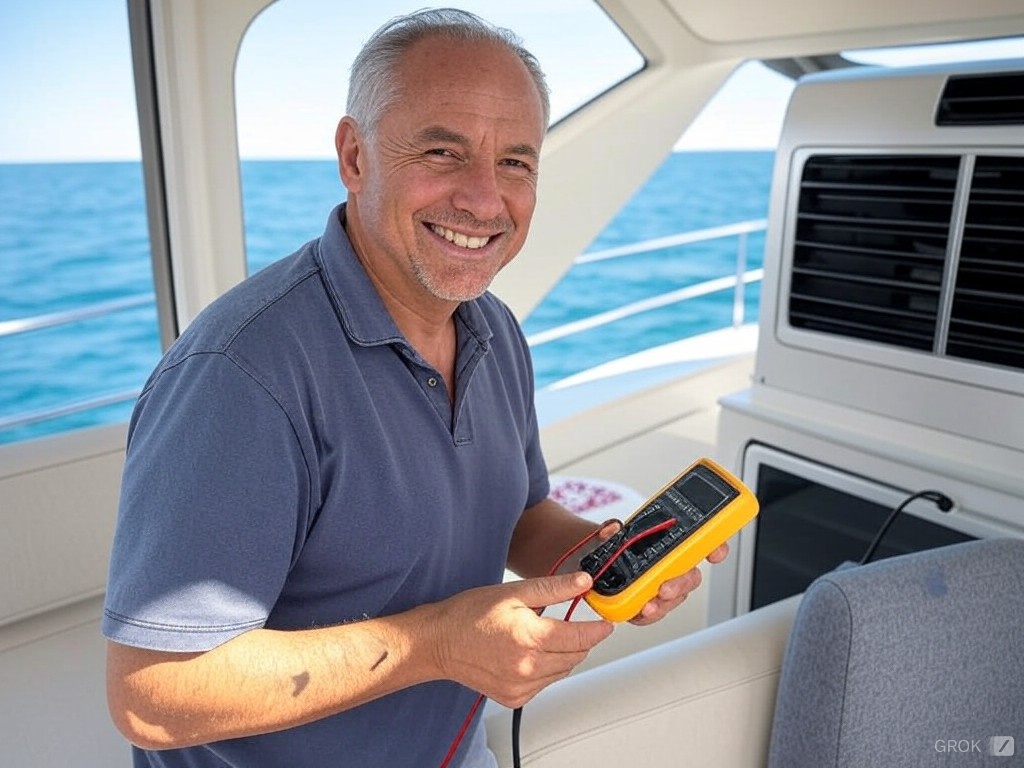
Voltage issues are one of the most common culprits behind underperforming DC-powered refrigeration systems. If your compressor struggles to start, runs inefficiently, or shuts off entirely, it’s often caused by an inadequate power supply. In this guide, we’ll show you how to test your fridge and detect voltage issues using a common multimeter. Identify potential issues before they arise and ensure your unit operates reliably before your next adventure.

What You’ll Need

  • A DC-powered refrigeration unit (e.g., your Ozefridge system).
  • A digital multimeter.
  • Power supply cables or jumper leads.

Step 1: Measure the Voltage at Rest

  1. Set your multimeter to measure DC voltage.
  2. Connect the multimeter to your fridge’s power supply lines while the unit is off.
  3. Take a reading.
    • Expected Voltage: You should see a voltage of around 14.2 volts if the battery or power source is healthy.
    • At this stage, the power supply is at rest with no load.

Why This Matters: A healthy battery or power supply should deliver a steady voltage before any current is drawn.

Step 2: Test the Voltage Under Load

  1. Turn on the refrigeration unit.
  2. Watch the voltage reading on the multimeter.
  3. Observe what happens as the compressor starts:
    • A slight voltage drop is normal. For example, the voltage might dip briefly from 14.2 volts to around 11.9 volts.
    • However, if the voltage drops significantly—below 12 volts—this indicates a problem.

Example Scenario:

  • Initial Voltage: 14.2V
  • Voltage Under Load: 11.9V

What This Means: A drop to 11.9 volts suggests the power supply or cables are inadequate, but still enough to keep the compressor running.

Step 3: Test with Thinner or Faulty Wiring

To simulate a worse power supply scenario:

  1. Replace the regular power cables with a jumper lead or thinner wire.
  2. Start the refrigeration unit and observe the voltage drop on the multimeter:
    • As the compressor tries to start, the voltage may drop dramatically—down to 10 volts or lower.
    • If the voltage dips below 8 volts, the compressor may fail to start entirely, triggering an overload protection shutdown.

Example Scenario:

  • Initial Voltage: 14.2V
  • Voltage Under Load (Faulty Wiring): 7.9V–8.0V

What Happens: The compressor overloads and fails to start due to insufficient power.

Understanding the Results

  • Healthy Power Supply: Voltage remains above 12 volts under load, with only minor dips.
  • Inadequate Power Supply: Voltage drops below 12 volts, which may cause the compressor to struggle.
  • Severe Power Supply Issue: Voltage falls below 8 volts, preventing the compressor from starting at all.

Why Voltage Drops Matter

Voltage issues can arise from:

  • Undersized Cables: Power cables that are too thin cause resistance and voltage loss.
  • Battery Issues: Weak or undercharged batteries cannot deliver the necessary power.
  • Poor Connections: Corroded terminals or loose connections restrict power flow.

When your refrigeration system operates at low voltage:

  • The compressor struggles to start.
  • Power consumption increases, leading to inefficiency.
  • The system can fail completely if overload protection is triggered repeatedly.

How to Fix Voltage Issues

If you’ve detect voltage issues or significant voltage drops:

  1. Inspect Your Wiring: Ensure cables are thick enough to handle the current.
  2. Check Your Battery: Test for charge levels and replace if necessary.
  3. Clean Connections: Ensure terminals and connectors are clean and secure.
  4. Upgrade Your Setup: Use quality cables and a robust power supply for reliable performance.

Final Tip

A multimeter is a simple but powerful tool for identifying power issues in your DC-powered refrigeration system. By following these steps, you can quickly pinpoint the cause of voltage drops and keep your fridge running efficiently—whether you’re on the water, off-grid, or on the road.

If you need further advice, the team at Ozefridge is always here to help! Contact us for expert support and solutions tailored to your needs.

Keeping food fresh and drinks cold while off the grid can be a challenge, especially when you’re relying on limited power sources. That’s where eutectic refrigeration steps in as a game-changer. This innovative cooling method is designed to be energy-efficient, reliable, and ideal for adventurers, whether you’re on a boat, in a caravan, or living remotely.

If you’re tired of fridges that drain your battery or stop working when power is scarce, eutectic refrigeration might be the perfect solution for you. Let’s explore how it works and why it’s the go-to choice for off-grid living.

What is Eutectic Refrigeration?

Eutectic refrigerators use special cooling plates, known as eutectic plates, to store cooling energy. Think of these plates as thermal batteries. When energy is abundant—like when your solar panels or generator are running—these plates “charge” by freezing. Once frozen, they slowly release the stored cooling energy, keeping your fridge at the perfect temperature for hours without needing continuous power.

This system is incredibly efficient because it maximises the use of available energy and minimises battery drain. It’s a smarter way to stay cool, even in the most remote locations.

How Eutectic Cooling Works

Essentially, the eutectic cooling cycle consists of three stages:

  1. Charge: Eutectic plates freeze when there’s plenty of energy, like during the day when solar panels are producing power.
  2. Store: The frozen plates hold the cooling energy, much like a fully charged battery.
  3. Cool: As the fridge operates, the plates release their stored energy, maintaining a consistent temperature without the need for constant power.

This system ensures that even if your power source is interrupted, your food and drinks stay cold for hours.

Why Eutectic Refrigeration is Perfect for Off-Grid Living

whether you’re on a yacht, on a camping trip, or living in a remote area, the eutectic cooling method is a a perfect alternative to traditional refrigeration. Here’s why:

Energy Efficiency

Eutectic cooling systems are designed to make the most of your available power. By storing cooling energy during peak times, it reduces the need for constant electricity. This means you can stretch your battery life and rely less on backup power sources.

Reliable Performance

Whether you’re on a multi-day boating trip, camping in the outback, or living in a remote location, eutectic refrigeration ensures your fridge stays cold—even when the power’s off. No more worrying about spoiled food or warm drinks.

Versatility

From caravans to boats and even remote homes, eutectic refrigeration adapts to your lifestyle. It’s a practical choice for anyone who values energy efficiency and reliability on the go.

Cost-Effective

While the initial investment might be slightly higher, eutectic systems save you money in the long run. By reducing battery demand and maximising solar or generator efficiency, it lowers your energy costs and extends the life of your power systems.

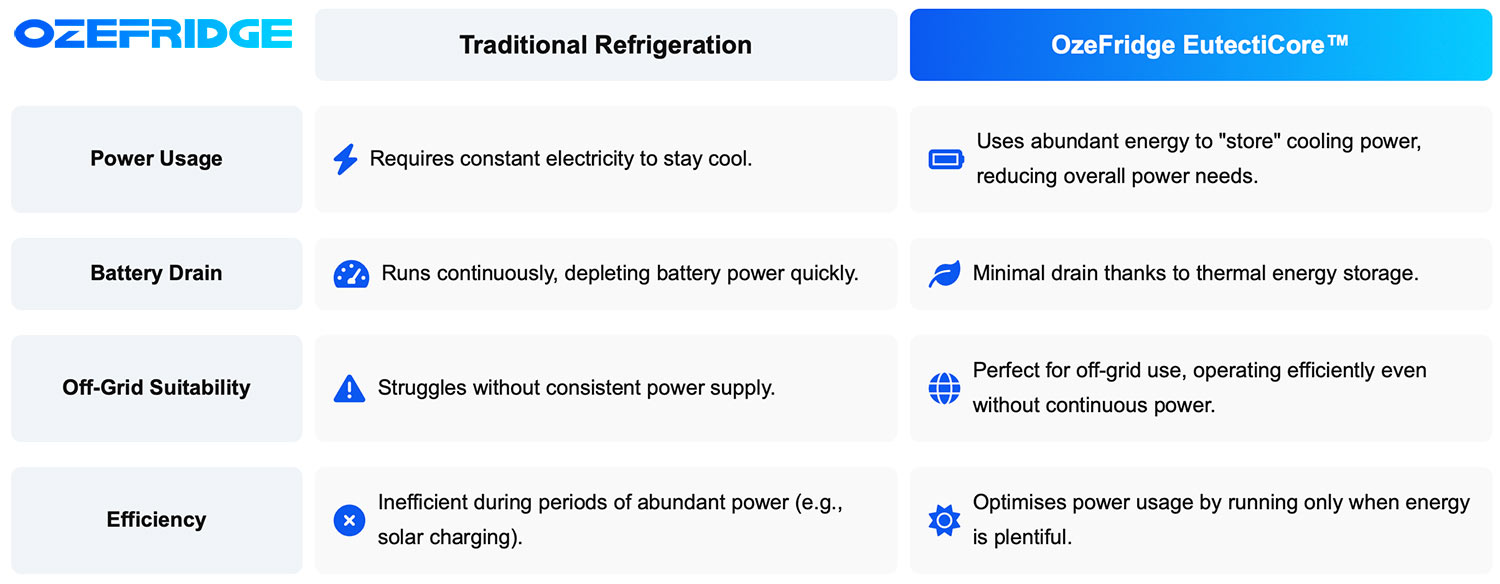
Traditional vs. Eutectic Refrigeration

When compared to traditional refrigeration, the benefits of eutectic systems become even clearer:

Comparison of Traditional vs Eutectic Refrigeration by Ozefridge - The world's most energy-efficient refrigeration

Comparison of Traditional vs Eutectic Refrigeration by Ozefridge Australia

For boating enthusiasts and off-grid adventurers, the choice is simple. A eutectic fridge or fridge-freezer is better suited to remote and unpredictable conditions.

Real-Life Applications of Eutectic Refrigeration

Here are just a few ways eutectic refrigeration makes life easier:

  • On the Water: Imagine setting sail for a multi-day journey. With Ozefridge eutectic refrigeration, you can keep your catch fresh and your drinks cold without worrying about power.
  • On the Road: Caravan travellers love our eutectic systems for their ability to maintain cooling during long drives or overnight stops without hookups.
  • At Home, Off the Grid: For those living in remote areas, Ozefridge eutectic refrigeration provides a reliable cooling solution during power outages or limited solar availability.

Why Choose Ozefridge for Eutectic Refrigeration?

At Ozefridge, we’ve perfected the art of off-grid refrigeration with our advanced EutectiCore technology. Here’s what sets us apart:

  • Energy Efficiency: Our systems are designed to make the most of your power, giving you reliable cooling without draining your resources.
  • Durability: Built with copper and stainless steel, Ozefridge units are made to withstand the toughest conditions.
  • Customer Support: As a family-owned business, we pride ourselves on supporting our customers long after the sale. Whether you need repairs, parts, or advice, we’re here to help.

Elevate Your Adventures with Ozefridge

If you’re ready to experience the benefits of our low voltage refrigeration for yourself, explore our range of Ozefridge EutectiCore systems or contact our team for expert guidance.

Stay cool, stay efficient, and stay adventurous with Ozefridge!