Power on a boat is hard to keep steady. Solar and wind power change with the weather.
Most cruisers use batteries to store electricity. But batteries have very limited space.
What happens when your boat batteries are full on a sunny day? Where does the extra solar power go?
You might think you need a bigger, heavy battery bank. But there is a much better way.
You can store that extra power as cold thermal energy.

What is “Eutectic” Storage?

To understand this, we need to look at how we measure heat. We measure heat in watts (just like electricity).
    • Sensible Heat: It takes 1 watt of cooling to drop the temperature of 1 litre of water by 1 degree Celsius. Please see Wikipedia about Sensible Heat.
    • Latent Heat: It takes a massive 93 watts of cooling to turn that same litre of water into solid ice. Please see Wikipedia about Latent Heat.

Turning liquid into ice stores a lot of cold energy! But plain water is not cold enough for a boat fridge. So, we add salt or glycol to the water. As a result, this new mixture is called a eutectic solution.
A eutectic solution  freezing at -5°C is ideal for a fridge. Additionally, it stores about 85 watts of cold energy per litre. This frozen mix acts like a giant battery for coldness.

How It Works: Reducing the Load on Your Batteries

A eutectic fridge looks like a normal fridge, but it has one big difference.
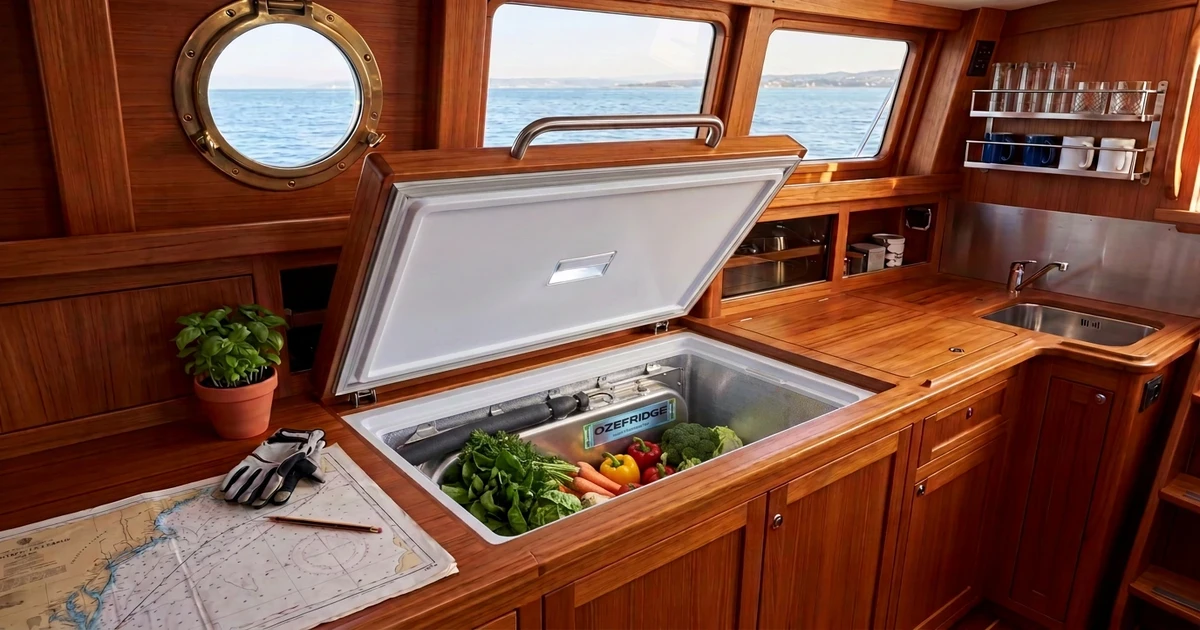
Instead of a thin metal cooling plate, it uses a tank filled with the eutectic liquid. Also inside the tank is the refrigeration cooling coil (technical refrigeration term “Evaporator”).

Here is how the cycle works:
    1. The Freeze: The fridge motor runs and turns the eutectic solution into ice.
    2. The Hold: The motor turns off.
    3. The Melt: The ice slowly melts, keeping your food cold for hours without using any electricity.

For example, a small 5-litre tank needs about 3.5 hours of continuous running to freeze solid.

Imagine it is midday and your solar panels are soaking up the sun. But your boat batteries are already 100% full. Instead of wasting that free solar power, your eutectic fridge turns on. The eutectic system instead uses that extra sun to freeze the eutectic solution. So at night, the fridge can stay off while the frozen eutectic solution keeps your food cold. As added benefit, your batteries can then focus on powering your lights and navigation tools.

COP: The Secret to High Efficiency

Efficiency is measured by COP (Coefficient of Performance). This is the amount of heat a fridge removes for every watt of power it uses. The higher number, the more efficient the fridge is.

Eutectic fridges are far more efficient than standard (cyclic) fridges for two major reasons:

1. Better Temperatures
    • Standard Fridges: They turn on and off quickly due to lack of thermal storage (it is just a thin aluminium plate after all). To compensate for this, they must run at a freezing -23°C much like their version of cooling in advance. However, this gives them a poor COP of 1.01.
    • Eutectic Fridges: They hold their coldness better due to the frozen eutectic mass constantly absorbing heat. They only need to run at -10°C to keep the food at a perfect 2°C. This gives them a great COP of 1.41.

2. Fewer Startups
Pushing a stationary car into motion takes more energy than keeping it moving. Fridge motors are the same. As a result, starting up uses 30% to 100% more current for a few seconds.
    • Standard Fridges: Turn on and off 40 times a day. This wastes power. On top of that, each time a motor/compressor start puts tremendous strain on mechanical and electrical parts. Therefore, life expectancy is reduced. 
    • Eutectic Fridges: Only turn on 1 or 2 times a day. They run for a long time, freeze the block, and shut off. This saves your energy and protects your equipment.


Summary

A eutectic fridge does two jobs at once: It keeps your food fresh, and it acts as a secondary storage bank for your extra electrical power. This is the smartest way to upgrade your boat.

Want to find the perfect setup for your boat? Use our Ozefridge Heat Load Calculator to discover exactly what you need for your next cruise!

 

Keeping your cool on board can be a challenge. Wet sails, a stressed-out crew, spoiled food, and warm drinks, does this sound familiar?

While we cannot fix the weather or the crew, we can definitely solve your galley woes. Nothing turns sailing stress into absolute bliss quite like a crisp, ice-cold drink. To achieve that bliss, today’s mariners need a reliable marine refrigeration system that actually works, thrives on minimal power, and stops causing aggravations. Here is how modern marine technology is unlocking the confusion of on-board cooling.

How Refrigeration Actually Works

The biggest mystery to unlock about refrigeration is this: systems lower temperatures by removing heat, not by adding cold.
Please see refrigeration Wikipedia page to learn more. A marine refrigeration system works in a continuous recycling loop using three major components:
    • The Evaporator: Located inside your fridge cabinet, acting as the heat collector.
    • The Condenser: Located outside the cabinet, acting as the heat disposer.
    • The Compressor: The pump that circulates refrigerant gas between the two.
    • Refrigerant Metering Device: Provides pressure drop to enable evaporation of liquid refrigerant in the Evaporator and thereby collecting large amounts of heat in the process.

Think of it like the water-cooling system in your car. Gas circulates through the loop, absorbing heat from inside the fridge and dumping it outside.

If your condenser cannot get rid of that heat efficiently, the whole loop gets choked. A restricted condenser forces the system to run excessively, drain your battery bank, and fail to cool when the weather gets hot.

Marine Refrigeration: Unlocking the Confusion

At its core, a marine refrigeration is just a domestic refrigerator that can run on battery power. However, standard household units cannot handle the harsh marine environment.

Modern marine refrigeration systems operate seamlessly on 12-24VDC and 110-240VAC power. Purpose-built for boats, they are engineered to handle erratic power supplies, extreme tropical temperatures, and acute sailing angles. Best of all, they are simple enough to install as a DIY weekend project.

The Eutectic Advantage: Power-Saving Magic

We all know a drink with ice stays perfectly cold until the ice melts, and then warms up rapidly. That ice uses the eutectic prinicipal by taking advantage of its Latent Heat during its phase change. During phase change from ice-to-water and vice versa, it requires 80 times more thermal energy compared to just adding a water’s temperature by just one degree. A Eutectic Marine Refrigeration System uses this exact phenomenon. Instead of a standard aluminium evaporator plate, it utilizes a specialized liquid solution stored in a eutectic tank. This solution acts like a heavy-duty, renewable ice block inside your fridge. This delivers incredible benefits for boat owners such as:
    • Massive Hold-Over Times: The unit can stay turned off for hours—or even days in cooler weather—without the cabinet temperature rising.
    • Lower Overall Consumption: Saturated cooling environments are highly efficient, meaning far fewer battery-draining stop/start cycles for your compressor.
    • Lighter Weight: Storing thermal energy in a eutectic tank weighs a third less than storing the equivalent electrical energy in extra batteries.
    • Sunless Sailing: If your solar panels get zero sun for a day or two, your fridge keeps everything cold using stored thermal energy.

To learn more, please see “How Eutectic Refriegration Works” blog to learn more.

Why the Ozefridge Voyager Series Ticks Every Box

If you want the most efficient, reliable eutectic marine refrigeration system on the market, the Ozefridge Voyager Series powered by EutectiCore is designed specifically to conquer harsh marine conditions.
    • Smart Power Auto-Switching: Operates on 12/24VDC and 110/240VAC, automatically switching to AC power whenever you plug into shore power.
    • Dual Cooling Options: All Voyager Systems have either the A490 or the AW490 Condenser/Compressor unit. The A490 unit (Air Cooled ONLY) is suitable for well-ventilated areas otherwise the AW490 unit (Air & Water Cooled) is recommended. 
    • Anti-Electrolysis Technology: A unique 3-pass water-cooling design eliminates the risk of electrolysis, preventing gas leaks and system damage.
    • ECO2 Automation: Intelligent power management monitors your system to maximize cooling when excess power is available. Runs the fridge when power is abundant (like peak solar hours or while motoring) and keep it off overnight.
    • Heavy-Duty Build: Housed in a rugged stainless steel case with rubber shock mounts, featuring bolt-together eutectic tanks to eliminate the stress cracks common in welded alternatives.
    • Easy Maintenance: Equipped with genuine refrigeration service valves and digital controls featuring an exclusive “Sure-Thaw” facility to ensure perfect eutectic cycling.

Conclusion

Don’t let spoiled food and warm drinks ruin your time on the water. Invest in a purpose-built marine refrigeration system that works with your boat’s power grid, not against it.

Cool it with Ozefridge, relax, and enjoy your time on the water.

Not sure what suits your needs, please see our Ozefridge Heat Load Calculator to find out what system you need.


When embarking on an adventure at sea, the last thing you want is to worry about your refrigeration system failing. Whether you’re a seasoned sailor or a weekend boater, having a dependable marine refrigeration system is crucial. In Australia, where the marine lifestyle is thriving, understanding the nuances of marine refrigeration can make all the difference. This guide will delve into the essentials of marine refrigeration in Australia, helping you make informed decisions for your next voyage. For a deeper understanding of refrigeration systems, you might find this Wikipedia page on refrigeration helpful.

Understanding Marine Refrigeration Systems

Marine refrigeration systems are specifically designed to withstand the unique challenges of the marine environment. Unlike standard household refrigerators, these systems are built to operate efficiently on boats, where power supply and space are often limited. DC refrigeration systems, in particular, are popular in Australia due to their energy efficiency and reliability. They run on direct current, making them ideal for boats that rely on battery power.

When choosing a marine refrigeration system, it’s essential to consider factors such as energy consumption, cooling capacity, and durability. DC systems are known for their low power draw, which is a significant advantage when you’re out at sea for extended periods. Additionally, these systems are designed to handle the constant movement and vibrations of a boat, ensuring your food and drinks stay cool even in rough waters.

Why Choose DC Refrigeration for Your Sea Adventures?

DC refrigeration systems offer several benefits that make them a preferred choice for marine enthusiasts in Australia. Firstly, they are incredibly energy-efficient, which is crucial when you’re relying on limited power sources like solar panels or batteries. This efficiency not only helps conserve energy but also reduces your overall environmental footprint.

Moreover, DC systems are compact and lightweight, making them easy to install in the confined spaces of a boat. Their robust construction ensures they can withstand the harsh marine environment, providing reliable cooling performance even in extreme conditions. With a DC refrigeration system, you can enjoy your adventures without worrying about power shortages or system failures.

Addressing Common Challenges in Marine Refrigeration

One of the main challenges boat owners face is maintaining a consistent power supply for their refrigeration systems. In Australia, where the sun is abundant, solar panels are a popular solution for powering DC refrigeration systems. By harnessing solar energy, you can keep your system running efficiently without draining your boat’s battery.

Another common issue is the limited space available on boats. Marine refrigeration systems are designed to be compact, but it’s still essential to plan your layout carefully. Consider the size of your fridge and freezer, as well as the available storage space on your boat. Opt for models that offer flexible storage options, such as adjustable shelves and removable bins, to maximise your storage capacity.

Tips for Maintaining Your Marine Refrigeration System

Proper maintenance is key to ensuring the longevity and performance of your marine refrigeration system. Here are some practical tips to keep your system in top condition:

  • Regular Cleaning: Clean the interior and exterior of your fridge regularly to prevent the build-up of dirt and grime. Use a mild detergent and a soft cloth to avoid damaging the surfaces.
  • Check Seals and Gaskets: Inspect the door seals and gaskets for any signs of wear or damage. Damaged seals can lead to air leaks, reducing the efficiency of your system.
  • Monitor Temperature Settings: Ensure your fridge is set to the optimal temperature for your needs. Overcooling can waste energy, while undercooling can lead to food spoilage.
  • Inspect Electrical Connections: Regularly check the electrical connections and wiring for any signs of corrosion or damage. Faulty connections can lead to power issues and system failures.

By following these maintenance tips, you can ensure your marine refrigeration system remains reliable and efficient, allowing you to focus on enjoying your adventures at sea.

Ready to upgrade your marine refrigeration system? Get a FREE Quote from Ozefridge today and experience the difference of reliable DC refrigeration on your next adventure.

Embarking on a maritime adventure is a dream for many, but ensuring your journey is comfortable and efficient requires the right equipment. At the heart of this preparation is the boat fridge freezer, a crucial component for any seafaring vessel. Whether you’re a seasoned sailor or a weekend warrior, understanding the importance of reliable DC refrigeration can transform your boating experience. According to a Wikipedia article on refrigeration, refrigeration is essential for preserving food and beverages, making it a vital consideration for extended trips on the water.

The Importance of a Boat Fridge Freezer

When you’re out at sea, the last thing you want is to worry about spoiled food. A boat fridge freezer ensures that your perishables remain fresh, providing peace of mind and the convenience of home. Imagine setting sail for a week-long trip, only to find your food has gone bad within the first few days. This scenario is not only inconvenient but can also be a safety concern. Investing in a high-quality boat fridge freezer can prevent such mishaps, allowing you to focus on the adventure ahead.

Choosing the Right DC Refrigeration System

Selecting the right DC refrigeration system for your boat is crucial. Consider your specific needs: How long will you be at sea? How much storage do you require? What is your power source? These questions will guide you in choosing a system that fits your lifestyle. DC refrigeration systems are designed to be energy-efficient, making them ideal for boats where power conservation is key. Look for models that offer adjustable temperature settings and are built to withstand the marine environment.

Overcoming Common Challenges With Boat Fridge Freezers

Boaters often face challenges such as limited space and power supply. A compact and efficient boat fridge freezer can help overcome these obstacles. Many modern units are designed with space-saving features, ensuring they fit seamlessly into your boat’s layout. Additionally, DC-powered models are engineered to operate efficiently on limited power, making them perfect for off-grid adventures.

Maintenance Tips for Longevity

To ensure your boat fridge freezer serves you well for years, regular maintenance is essential. Start by cleaning the interior regularly to prevent odors and mold. Check the seals for any signs of wear and tear, as these can affect the unit’s efficiency. It’s also important to monitor the power supply and ensure the system is operating within its recommended voltage range. By following these simple steps, you can extend the life of your refrigeration unit and maintain its performance.

Enhancing Your Boating Experience

A reliable boat fridge freezer not only preserves your food but enhances your overall boating experience. Imagine enjoying a cold drink while watching the sunset over the ocean or preparing a fresh meal with ingredients stored safely onboard. These small comforts can make a significant difference in your journey, turning a simple trip into an unforgettable adventure.

Why Choose Ozefridge?

At Ozefridge, we understand the unique needs of boaters and are committed to providing top-notch DC refrigeration solutions. Our products are designed with the latest technology to ensure reliability and efficiency, no matter where your adventures take you. We believe in powering your adventures with the best equipment, so you can focus on creating memories on the water.

Ready to upgrade your boating experience? Visit Ozefridge’s website to explore our range of boat fridge freezers and discover how we can help power your next adventure.