Just like a sturdy house needs a good foundation, a reliable fridge or freezer needs a well-insulated cabinet. Whether you are constructing a new well-insulated cabinet or using an existing one, this is a good place to start your refrigeration journey. Nothing spoils a great trip faster than warm drinks and ruined food. When your food and drinks stay cold, you can focus on the journey ahead.
The Golden Rule of Cooling
While it is near impossible to totally prevent heat penetration, there are a few key factors imperative to restricting heat entering.
A: Cabinet design.
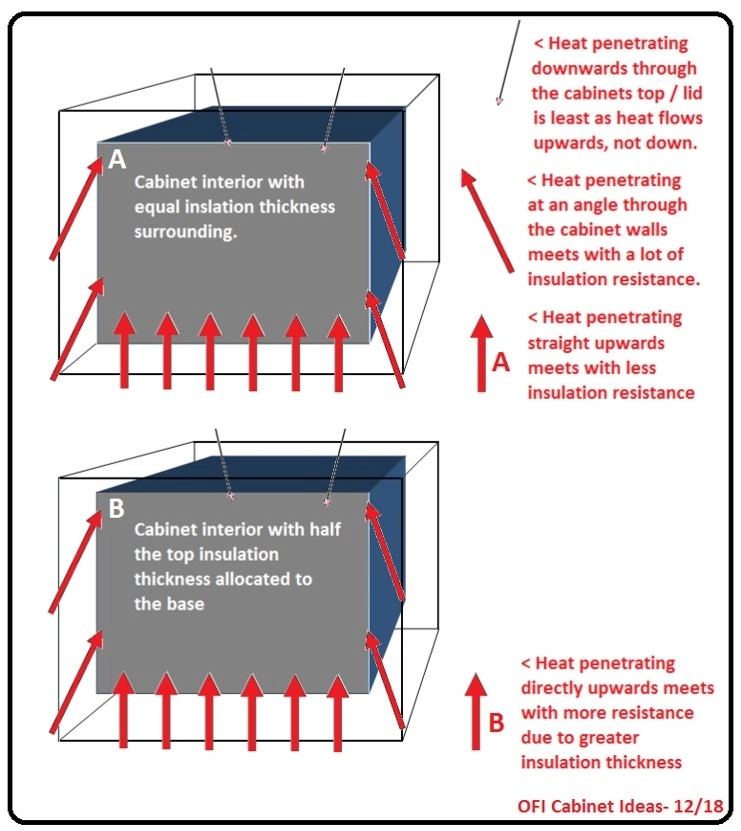
Heat naturally rises. Because of this, the greatest area subjected to heat penetration is the base. Proportionally, a tall-standing cabinet will have less exposed surface area at the bottom compared to the same cabinet dimensions laying down. Less surface area at the bottom means less heat potentially coming into the cabinet.
B: Insulation material.
A material’s thermal resistance is measured in R-value. The higher the number the better. There are other factors to consider but generally speaking, aim between R15 to R25.
In terms of insulation material, Polyurethane is the standard. Polyurethane has a better R value than Polystyrene, so choose this especially for tight spaces to get the desired R value.
Compromise might be necessary if ideal insulation thickness may not be practical. You can compromise by reducing the top of the cabinet’s insulation thickness 50% and adding that to the bass. This may work if the cabinet is NOT exposed to extreme sources of heat. This preserves your cabinet’s storage capacity and makes the bottom part easier to reach!!
C: Lining material.
Avoid conductive materials as lining. The insulated cabinet is trying to keep heat, you do not want to attract heat towards it. Not only that, conductive lining for the outside tends to act as a heat sink which makes the insulated cabinet’s job even harder. If conductive material is unavoidable, ensure that there is a thermal break which stops heat from conducting into the cabinet. Failure to do so and condensation spots will occur around the opening signifying thermal loss.
D: Vapour sealing.
This is extremely important especially for freezers. As your refrigeration system cools the cabinet, warm/moist air will try to exploit any gaps and unsealed parts of the cabinet insulation. This results in gradual build of moisture which then the insulation absorbs. This reduces the heat resistance of the insulation material thereby allowsing heat into the cabinet. There should be no water getting into the insulation if you submerge the insulated cabinet. You can use Sikaflex to seal joins. You also need to seal the screws by removing them, fill the hole with Sikaflex then refitted. This ensures insulation integrity is preserved for longevity.
E: Lid / door seals.
Any material that compresses easily and forms a total air movement barrier is best. An example of this is a soft closed cell sponge. Normal domestic fridge seals are quite rigid and usually don’t work very well for these small cabinets. You can mechanically compress hollow rubber to perform the seal around the opening.
The best way to check your lid / door seal is to put a strong light inside the cabinet at night, close the lid/door then observe any escaping light areas as they will need attention.
F: Heat load.
A refrigeration mechanic can calculate a heat load based on the cabinet dimensions and the factors above. They would then design a refrigeration system to suit your needs. You can also determine an estimate daily power consumption based on this results. This estimate should relate to extreme cases so you know the refrigeration equipment will work no matter what.